

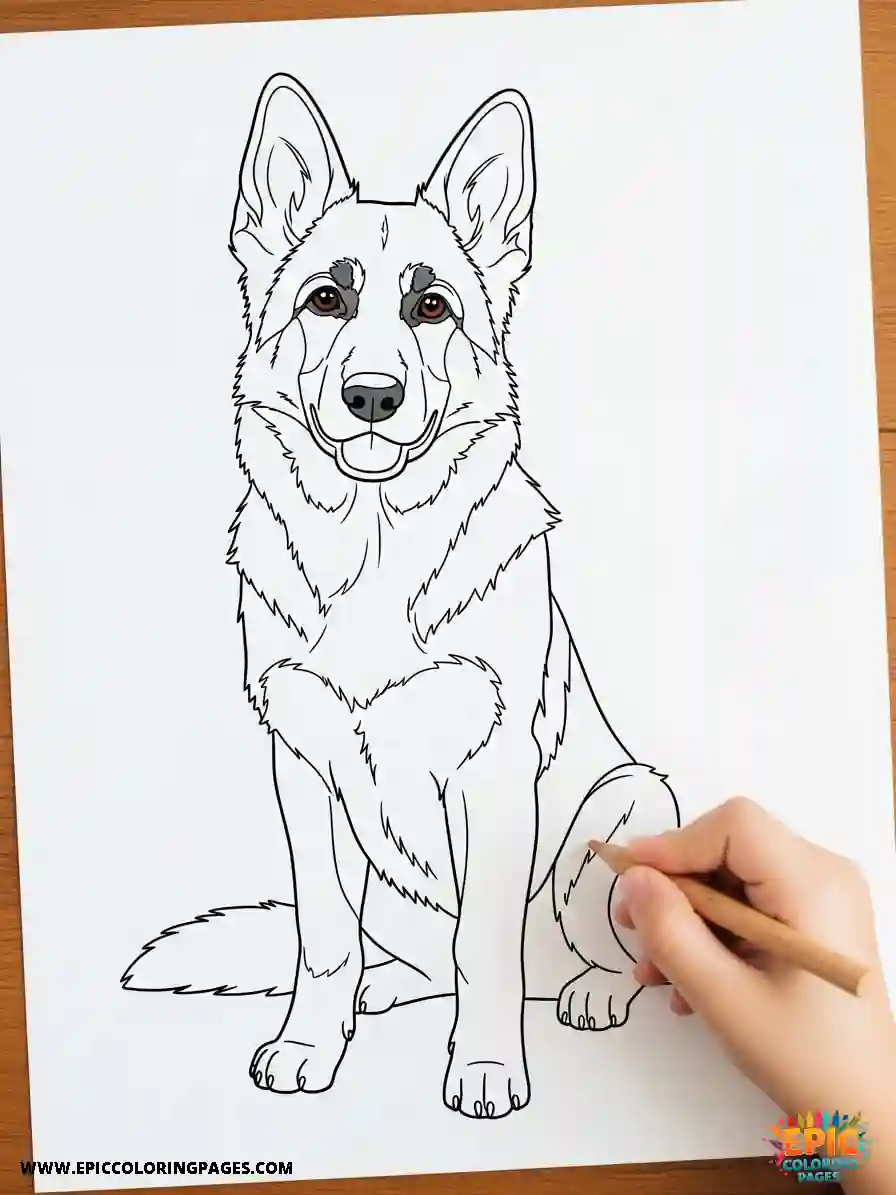
German Shepherd Dog Coloring Pages (268+ Free Printables)
Renowned for their unwavering loyalty, sharp intelligence, and striking noble appearance, the German Shepherd is one of America’s most beloved dog breeds. Whether you know them as courageous K-9 officers, dedicated service dogs, or simply as the goofy, lovable fluff-ball sleeping on your living room rug, these dogs hold a special place in our hearts. This collection celebrates the “Alsatian” in all its glory, offering a creative outlet for dog lovers to explore the breed’s distinct features through art.
Our carefully curated selection of 268+ free printable German Shepherd coloring pages celebrates every aspect of these remarkable dogs. From playful puppies with oversized paws to majestic adults in action poses, from realistic depictions showcasing their distinctive black and tan coat patterns to adorable cartoon versions that will make you smile this collection brings the German Shepherd’s charm to life on paper. Each design has been created with attention to detail and variety, ensuring that whether you’re a beginner picking up crayons for the first time or an experienced colorist seeking intricate challenges, you’ll find pages that match your skill level and artistic preferences.

Celebrating the Intelligence and Beauty of the German Shepherd
Beyond their physical beauty, German Shepherds are celebrated for their incredible versatility and working heritage. Originally bred for herding sheep, their role has expanded vastly over the last century. They are the stars of police forces, search and rescue teams, and the military, often seen as symbols of protection and bravery. This rich history provides a wonderful context for our coloring pages, allowing artists to color scenes that depict these dogs in their various heroic roles, or simply enjoying a game of fetch in the backyard.
When coloring these pages, you have the opportunity to experiment with a wide palette of earth tones. While the classic “black and tan” saddle pattern is the most recognizable, German Shepherds also come in solid black, sable, and bi-color varieties. This variety allows for great artistic freedom. Whether you are using colored pencils to capture the texture of their double coat or markers for a bold, vibrant look, these designs offer a satisfying challenge for colorists looking to practice shading and texture techniques.
Explore Our German Shepherd Gallery
Below you’ll find our German Shepherd Dog coloring pages gallery, featuring a wide range of illustration styles. You’ll see designs inspired by animation style, cartoon, chibi, manga, anime, kawaii, and realistic artwork, so you can choose the pages that best match your mood or coloring preferences.


Professional Coloring Tips for German Shepherd Dog Pages
Bringing a German Shepherd to life through coloring is both an artistic challenge and a rewarding experience. These intelligent, noble dogs have distinctive features that deserve careful attention from their alert expressions to their luxurious double coats. Whether you’re just starting out or you’ve been coloring for years, understanding the unique characteristics of German Shepherds will help you create more realistic and expressive artwork.
Understanding German Shepherd Coat Colors and Patterns
German Shepherds are famous for their rich, varied coloring. The most recognizable is the classic black and tan pattern, where deep black creates a “saddle” across the back while warm tan colors the chest, legs, and face. However, these dogs come in several color variations worth exploring in your coloring projects.
The sable coat presents a fascinating challenge for colorists. Each individual hair contains multiple color bands typically starting with tan or gray at the base and darkening toward the tip. This creates a stunning wolfish appearance that seems to shimmer and shift. To capture this effect, layer your colors gradually, starting with lighter tones as your foundation and adding darker shades in short, directional strokes that follow the hair growth pattern.
Solid black German Shepherds possess an elegant, uniform appearance that might seem simple at first glance, but presents its own artistic opportunities. Black isn’t truly flat it contains subtle variations in value that reveal form and texture. Use dark grays and blues in areas where light hits the coat, and reserve your deepest blacks for shadows and recesses. This approach creates dimension that prevents your work from looking flat.
Some German Shepherds sport a black and silver combination, where cool silver-gray replaces the warm tan tones. This color scheme offers a striking, sophisticated look. When working with these cooler tones, pay attention to how the silver catches light it often appears almost white in highlight areas while maintaining its gray character in mid-tones.
Capturing the German Shepherd's Distinctive Features
The German Shepherd face conveys intelligence and alertness that defines the breed’s character. Their dark, almond-shaped eyes should be your focal point. Leave a tiny highlight in each eye to create that spark of life and awareness. The eyes typically appear very dark brown or black, but adding the slightest touch of warm brown in the lighter areas makes them more lifelike than using solid black alone.
Those iconic pointed ears deserve special attention. German Shepherds have large, erect ears with slight rounding at the tips. The inner ear is typically lighter in color, often showing pink skin tones at the base. Create depth by making the inner ear lighter than the outer ear, and add subtle shadows where the ear meets the head to give it dimension and suggest how it curves.
The German Shepherd nose is another defining feature broad and always black. While it might be tempting to color it solid black, introducing very subtle highlights along the top edge where light naturally hits will make it appear three-dimensional rather than flat. The area where the nose meets the muzzle often shows slight texture, which you can suggest with gentle stippling or short marks.
Mastering the Double Coat Texture
German Shepherds possess a thick double coat that gives them their characteristic appearance. The undercoat is soft and dense, while the outer coat consists of longer guard hairs. Understanding this structure helps you create realistic texture in your coloring.
For the longer fur around the neck (often called the “mane”), use longer, flowing strokes that follow the natural direction of hair growth. This fur radiates outward from the neck and lies flatter along the body. The fur on the legs is shorter and smoother, requiring shorter, tighter strokes or even gentle blending.
The tail full and bushy, hanging in a slight curve provides an excellent opportunity to practice layering fur texture. Start with your base color and add darker tones along the underside and where individual hair clumps would create natural shadows. Then add lighter highlights on top where the fur would catch light. This three-dimensional approach makes the tail appear thick and luxurious rather than flat.
Pay attention to how fur appears different lengths in different areas. The fur is shortest on the face and front of the legs, medium length on the body, and longest on the tail, back of the thighs (creating “feathering”), and around the neck. Varying your coloring technique to match these different lengths creates authenticity.
Color Blending Techniques for Realistic Results
German Shepherds’ coloring naturally transitions from one shade to another rather than presenting hard lines between colors. The gradual shift from black to tan creates their distinctive appearance, and capturing these transitions is key to realistic coloring.
When working with colored pencils, layer your colors gradually rather than pressing hard immediately. Start with light pressure to establish your lightest tones, then build darker values slowly. This allows you to control transitions more easily. Where black meets tan, create a transitional zone where the two colors mingle very light tan strokes into the black area and light black strokes into the tan area.
For markers, which can be less forgiving, work from light to dark and allow each layer to dry before adding the next. Use a lighter tan or gray marker first to establish your mid-tones, then add your darkest values. Colorless blender markers can help soften transitions if you work quickly while the ink is still slightly wet.
If you’re using crayons or other opaque mediums, consider a technique called “feathering” where you use short, overlapping strokes in alternating colors to create the appearance of blending. This works particularly well for the German Shepherd’s coat where you want to suggest individual hairs rather than solid blocks of color.
Working with Light and Shadow
German Shepherds have muscular, athletic builds that deserve proper shading to convey their strength and form. Observe where shadows naturally fall on a dog’s body under the neck, beneath the belly, along the underside of the tail, and in the curve where the leg meets the body.
Light typically comes from above, meaning the top of the back, head, and legs receive the most light while the chest, belly, and undersides stay darker. Even within the black saddle marking, you’ll want subtle value changes to show form. Add a touch of dark gray or blue to black areas that catch light, keeping pure black for the deepest shadows.
The tan areas benefit from similar treatment. Your lightest tan (or even cream) appears where light hits directly often along the top of the muzzle, front of the chest, and front surfaces of the legs. Deepen the tan with burnt sienna or orange tones in shadowed areas to maintain warmth while suggesting dimension.
Don’t forget reflected light the subtle illumination that bounces back into shadow areas from surrounding surfaces. A thin edge of lighter color along the bottom of the belly or inside of the legs, even in shadow, prevents your shadows from appearing like flat black holes and adds realism.
Creating Authentic Backgrounds and Contexts
While the German Shepherd should be your primary focus, a thoughtful background enhances rather than distracts from your subject. German Shepherds are working dogs, so consider contexts that reflect their roles a training field, mountain landscape, or simple yard setting.
If your German Shepherd appears in a natural outdoor setting, remember that the background colors should complement rather than compete with the dog. Since German Shepherds feature warm tans and blacks, cool backgrounds of blues and greens create pleasing contrast. Conversely, if you want harmony, use earth tones throughout.
Keep background elements simpler and less detailed than your main subject. This creates depth through “atmospheric perspective” the artistic principle that closer objects appear more detailed and saturated while distant elements appear softer and lighter. You might color a background fence or trees with lighter pressure or looser strokes than you used for the dog’s fur.
For indoor scenes, consider how the environment’s colors might reflect onto the dog. A German Shepherd lying on a blue rug might pick up subtle blue tones in its shadow areas. These color relationships, while subtle, add sophistication to your work.
Tips for Different Skill Levels
If you’re new to coloring, start with German Shepherd illustrations that have clear, bold outlines and distinct color areas. Focus on getting comfortable with basic color placement before worrying about advanced techniques. Use just two or three colors initially perhaps a tan, brown, and black to establish the basic pattern. You can always return to add more nuance later.
As you gain confidence, experiment with expanding your color palette. Real German Shepherds’ coats contain surprising variety hints of red in the tan areas, warm browns in transition zones, even subtle grays in the black. Notice how professional dog photography reveals these colors, and try incorporating them into your work.
Advanced colorists might challenge themselves by working from reference photos of real German Shepherds. Notice the exact placement of markings no two German Shepherds are identical. Some have more extensive black saddles, others more tan. Some show darker masks on their faces while others have lighter, more open expressions. These individual variations make each coloring project unique.
Try different mediums and combinations. Layer markers over colored pencils for rich, varied textures. Use gel pens for individual highlighted hairs or whiskers. Experiment with white pencil or gel pen over darker colors to create the brightest highlights. Each medium offers different possibilities.
Common Mistakes to Avoid
One frequent error is making the entire dog one uniform color within each marked section all one shade of tan, all one shade of black. Real fur has dimension, with lighter and darker areas even within a single color zone. Always include value variation.
Another pitfall is outlining every section with heavy black lines. While your coloring page includes printed lines, you don’t need to emphasize them with your coloring. In fact, softening or even “coloring over” some of these lines where they fall in highlight areas creates a more naturalistic appearance.
Don’t neglect the eyes. They’re essential for expression and character. Many colorists spend significant time on the fur but rush through the eyes, yet viewers will notice lifeless eyes immediately. Take time to observe how light reflects in dogs’ eyes and recreate that sparkle.
Avoid making shadow areas muddy by mixing too many different colors. Keep your shadow palette simple and consistent. If you’re adding blue to your shadows, use blue throughout rather than blue in some areas and purple in others.
The Joy of Creative Freedom
While these tips focus on realistic coloring, remember that your coloring pages are opportunities for creative expression. Perhaps you’d like to color a German Shepherd in fantastical colors purple and turquoise, or sunset oranges and pinks. Maybe you’ll add decorative patterns to the coat or create an imaginative background filled with stars or flowers.
The wonderful thing about coloring is that it’s simultaneously accessible and limitless. You can follow realistic color schemes or venture into pure imagination. You can complete a page in one sitting or return to add layers and details over several sessions. There’s no single correct approach.
German Shepherds themselves are remarkable dogs loyal, intelligent, versatile, and beautiful. Whether you’re coloring them as a relaxing activity, as artistic practice, or as a way to celebrate these incredible animals, each page offers an opportunity to engage with their distinctive characteristics and create something uniquely yours.
Take your time, observe carefully, and enjoy the process. Every stroke adds to your skills and brings your German Shepherd to life.
More Dog Breeds to Color
If you enjoyed these German Shepherd designs, don’t stop here! We have a massive library of canine companions waiting for you to bring them to life with color. From tiny Chihuahuas to giant Great Danes, our collection covers the entire canine kingdom.
Access our complete page of dog coloring pages.
Frequently Asked Questions and Interesting Facts About German Shepherds
How long do German Shepherds live?
German Shepherds typically live between 9 to 13 years, with proper care, nutrition, and regular veterinary check-ups playing crucial roles in their longevity. Some have been known to live even longer when they maintain a healthy weight, get adequate exercise, and receive preventive healthcare throughout their lives.
Are German Shepherds good with kids?
Yes, German Shepherds can be excellent with children when properly socialized and trained. They’re naturally protective and loyal, often forming strong bonds with family members. However, due to their size and energy, supervision with very young children is recommended, and early socialization is key to ensuring they’re gentle and patient around kids.
Do German Shepherds shed?
German Shepherds are heavy shedders year-round, with two major “blowing coat” periods in spring and fall when they shed even more profusely. Regular brushing (ideally daily) helps manage the shedding and keeps their beautiful double coat healthy. Many owners joke that German Shepherd hair is a permanent accessory!
How much is a German Shepherd?
German Shepherd puppies from reputable breeders typically cost between $500 to $3,000, depending on lineage, location, and whether they’re from show or working lines. Adoption from shelters or rescues usually costs $50 to $500. Remember that the initial purchase price is just the beginning quality food, veterinary care, training, and supplies add to the lifetime investment.
Are German Shepherds aggressive?
German Shepherds are not inherently aggressive, but they are naturally protective and territorial, which is why they excel as guard dogs. With proper socialization, training, and responsible ownership, they’re confident, calm, and friendly. Aggression typically results from poor breeding, inadequate socialization, abuse, or lack of proper training rather than breed temperament.
How to draw a German Shepherd?
Start by sketching basic shapes: an oval for the body, a smaller circle for the head, and triangular shapes for the erect ears. Add the distinctive sloped back, strong legs, and bushy tail. Focus on the alert, intelligent expression in the eyes and the noble head shape. Our coloring pages provide excellent references for proportions and features you can even trace them as practice before drawing freehand!
When does a German Shepherd stop growing?
German Shepherds reach their full height around 12 to 18 months old, but they continue filling out and developing muscle mass until they’re approximately 2 to 3 years old. Males typically grow larger than females, and growth rates vary based on genetics, nutrition, and overall health.
Are German Shepherds good with cats?
German Shepherds can coexist peacefully with cats, especially when raised together from a young age. Their herding instinct may cause them to chase at first, but with proper introduction, training, and supervision, many German Shepherds and cats become close companions. Individual temperament and early socialization are key factors in successful multi-pet households.
Are German Shepherds hypoallergenic?
No, German Shepherds are not hypoallergenic. They have a double coat that sheds considerably and produces dander, which is the primary trigger for pet allergies. People with dog allergies often find German Shepherds particularly problematic due to their heavy shedding. Those seeking hypoallergenic breeds should consider poodles, Portuguese Water Dogs, or other low-shedding breeds.
Does a German Shepherd bark a lot?
German Shepherds are vocal dogs who will bark to alert their family of strangers, unusual sounds, or perceived threats this is part of their guardian nature. However, excessive barking is not typical for a well-trained, properly exercised German Shepherd. With consistent training and adequate mental and physical stimulation, their barking can be managed and directed appropriately.
Where are German Shepherds from?
German Shepherds originated in Germany in the late 1800s, developed by Captain Max von Stephanitz who sought to create the ideal herding dog. He established the breed in 1899, selectively breeding dogs for intelligence, strength, trainability, and loyalty. The breed quickly gained recognition beyond herding, becoming one of the world’s most versatile working dogs.
Are German Shepherds dangerous?
German Shepherds are powerful, intelligent dogs that require responsible ownership, but they are not inherently dangerous. Their strength, protective instincts, and loyalty make them excellent working dogs, but these same traits require proper training, socialization, and leadership. In the hands of responsible owners, they’re loyal, obedient, and safe family companions.
Are German Shepherds easy to train?
Yes! German Shepherds are among the most trainable dog breeds, ranking third in intelligence according to canine experts. They’re eager to please, highly motivated, and capable of learning complex commands and tasks quickly. This trainability is why they excel as police dogs, service animals, and in competitive obedience. Consistency, positive reinforcement, and early training yield excellent results.
Why are German Shepherds police dogs?
German Shepherds are ideal police dogs due to their exceptional combination of intelligence, trainability, loyalty, courage, and physical ability. They have an outstanding sense of smell for detection work, the athleticism for pursuit and apprehension, the temperament to work calmly in stressful situations, and the strong bond with handlers that ensures reliability. Their intimidating appearance also serves as an effective deterrent.
Are German Shepherds herding dogs?
Yes, German Shepherds were originally bred as herding dogs in Germany, specifically to manage and protect sheep flocks. While many are now bred for companionship, protection, or other working roles, they retain their herding instincts. You might notice your German Shepherd gently “herding” family members, especially children, by circling or nudging this is their heritage showing through!